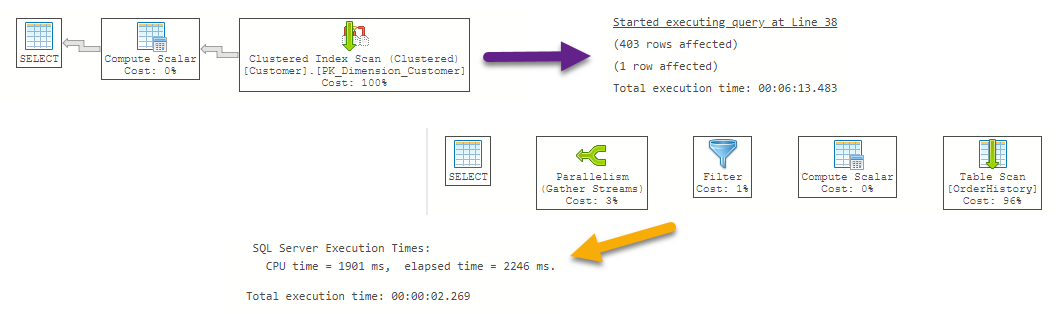
Historically the use of User Defined Functions aka UDF has represented a great option to encapsulate logic into Database reusable objects, nonetheless, during the implementation of scalar UDF (a variation based on the function’s output) for MS SQL Server we have been suffering painful performance penalties until the arrival of version 2019, so in this article, we are going to address how the new Scalar UDF Inlining feature helps us to avoid performance problems and get the maximum value in our Database code inside SQL Server.
Continue reading “Introduction to Scalar UDF inlining in MS SQL Server 2019”Category: T-SQL
Implementing CTE for filling gaps inside a sequence
This is the second article of a series dedicated to implementing Recursive Common Table Expression in different kind of scenarios, and this time I will address another use case; it basically consists in filling gaps inside a sequence of an incomplete range of dates. I would like to comment that the next example has been taken from MSDN forum, I have chosen because I think it is an excellent way to prove how versatile the recursive CTE is, the most creative solution was proposed by Peter Larsson (swePeso) and he brought us a valid and optimal implementation which is useful since SQL Server 2005 and up versions.
Continue reading “Implementing CTE for filling gaps inside a sequence”Using recursive CTE for generating a specific number of rows
I remember the first time that I discovered the amazing feature called Common Table Expression (CTE), it was during my first read of Itzik Ben-Gan book (T-SQL Querying), maybe one of the most interesting feature together with Windows Functions. I know, I am a declared fan of CTE, but we can start defining a CTE as a sort of temporary result set and which exists only during the lifetime of the query.
Continue reading “Using recursive CTE for generating a specific number of rows”
Dealing with errors for SQL_Variant datatype in MS SQL Server
I have to confess; I have had traumatic experiences with variant data type in my beginning as a software developer, in fact, I always have believed that it is an anti-pattern, at least in the OOP world, on the other hand in the Database world it gains much relevance, Why? Because of every column inside a table is supposed to be a specific datatype, otherwise, it could create a great number of conflicts and uncomfortable situations.
Continue reading “Dealing with errors for SQL_Variant datatype in MS SQL Server”

